Care · Decisions
Melasma, freckles and sun spots: why I treat one gently and the others firmly
How I combine picosecond 1064, 532 and 670 nm with long-pulsed 755 and 1064 nm lasers, gently for melasma alongside tranexamic acid, firmly for freckles and sun spots, and with PIH in mind for each skin type.
A woman in her thirties turns toward the window so I can see her cheeks. There are soft-edged brown patches across both cheekbones and a scatter of small, sharp dots over her nose. “Can you clear all of it in one session?” Not in one session, and not with one setting. The patches and the dots are different conditions, and they need different plans. (A composite of several consultations, not one patient.)
Melasma, freckles and sun spots respond differently to the same laser, and how likely your skin is to darken afterwards depends on your skin type. Below is how I tell them apart, why I treat melasma gently and freckles firmly, where the studies back me, where they made me change how I say it, and what to ask before you book.
Is it melasma, freckles or sun spots?
Everything after this depends on getting it right. Melasma is blotchy, usually symmetrical pigment on the cheeks, forehead or upper lip that sun and hormones make worse. It tends to come back; it is a condition you manage, not a stain you remove. Freckles are small, light brown dots that usually start in childhood and darken with sun. Sun spots, which doctors call solar lentigines, are flat, sharper-edged spots left by years of sun, usually larger and darker than freckles. Many patients I see have two or three of these on the same face, so I plan each area separately.
Before any laser, I make sure every spot is benign. A spot that is changing, or looks unlike the others, is examined properly first, and sometimes sampled, because a laser should never be aimed at a melanoma.
Why do I treat melasma gently?
Because even gentle laser, pushed too hard, can make melasma worse. In a split-face trial in 22 Asian patients, low-energy 1064 nm laser, often called toning, given weekly for five sessions with a hydroquinone cream, improved the melasma score by 75.9% against 24% on the cream-only side. Every patient’s melasma came back, three were left with mottled white spots and four with rebound darkening (Wattanakrai 2010). A review of 42 studies links those white spots to high accumulated laser energy, and notes that toning used aggressively can darken melasma, especially in darker skin (Lee 2022).
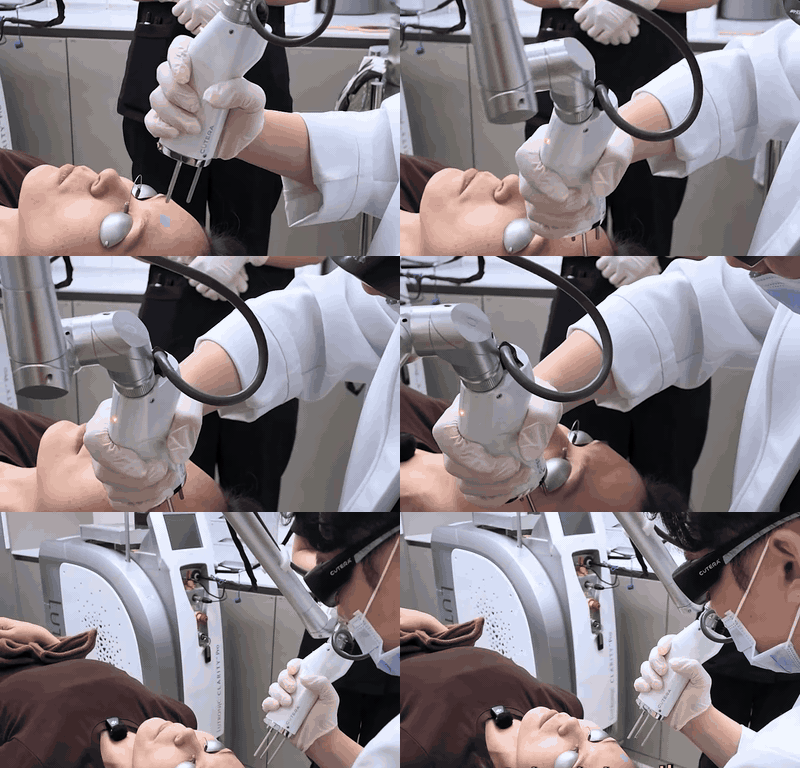
Those studies used Q-switched lasers. I apply the same principle with a picosecond 1064 nm, at low energy over a wide spot, with sessions weeks apart, and I judge progress in months, not visits. In a small split-face trial, picosecond and Q-switched 1064 nm showed no significant difference in melasma results (Feng 2023), though that does not prove my settings or schedule. I do not chase melasma with 532 nm or with strong single pulses. I think of it as calming the skin down, not attacking the pigment.
An international panel of 38 pigment specialists, published this year, puts sunscreen and prescription creams first, oral tranexamic acid as an alternative, and lasers for melasma that has not responded (Sarkar 2026). I agree with that order. When I use a laser for melasma, it is one part of the plan, never the whole plan.
What does tranexamic acid add?
Tranexamic acid is a tablet long used to reduce bleeding that also lightens melasma. Using it for melasma is off-label, so it is a prescription decision, not something to start yourself. In a placebo-controlled trial it lowered the melasma score by 49% over three months against 18% on placebo, and much of the gain faded within three months of stopping (Del Rosario 2018). Of 561 patients treated in Singapore, 89.7% improved, usually within two months, and about a quarter of those who improved relapsed later (Lee 2016). A comparison of six trials found the best-supported schedules were low doses over about 12 weeks (Wang 2023).
Adding the tablets to toning helped in a Korean trial of 48 patients (Shin 2013). Not every trial agrees: in a three-arm study, tablets plus a hydroquinone cream did far better than tablets plus two laser sessions (Elkamshoushi 2022). I read that as one more reason the laser should not carry melasma alone.
The tablet is not for everyone. In the Singapore series one patient developed a deep vein clot and was then found to have an inherited clotting disorder (Lee 2016). A retrospective matched study that left out people with clotting disorders, hormone use, pregnancy, smoking or previous clots found no detectable increase in clots; it cannot show the tablet is free of risk (Hernandez 2025). So before I prescribe, I ask about clotting history, hormonal contraception, pregnancy and breastfeeding, kidney problems, smoking and other medicines, and I do not prescribe when the answers point to risk.
Why do I treat freckles and sun spots firmly?
Because here the target is a small, defined collection of pigment, and the aim is to break it up in a few decisive sessions, not to nudge it month after month. With a 532 nm picosecond pulse, spot by spot, I look for the spot to turn slightly and briefly white as the pulse lands, the sign that the pigment has taken the energy. In my experience, energy that never reaches that point buys a run of sessions and little change. The studies I found do not test that directly; it is what I see.
The published numbers fit a decisive approach. In a prospective study of a picosecond laser of this kind at 532 nm on Asian skin, 93% of sun spots were more than 75% cleared after one session (Negishi 2018). In another small study, freckles needed one session on average to reach half clearance, against four and a half for melasma (Kung 2019). How many sessions you need, and how far a spot fades, still varies.
Firm does not mean as strong as possible, and this is where the evidence corrected my wording. In a study of 355 sun spots on Asian skin treated with two Q-switched lasers, clearance showed no significant difference between a slight and a very obvious whitening. The heavy endpoint left post-inflammatory darkening far more often: 33% against 7.5% with one laser, 23% against 8.5% with the other (Negishi 2013). So I aim for a slight, brief whitening, not the strongest reaction the spot can give. Enough to work, and no more.
Which laser for which spot?
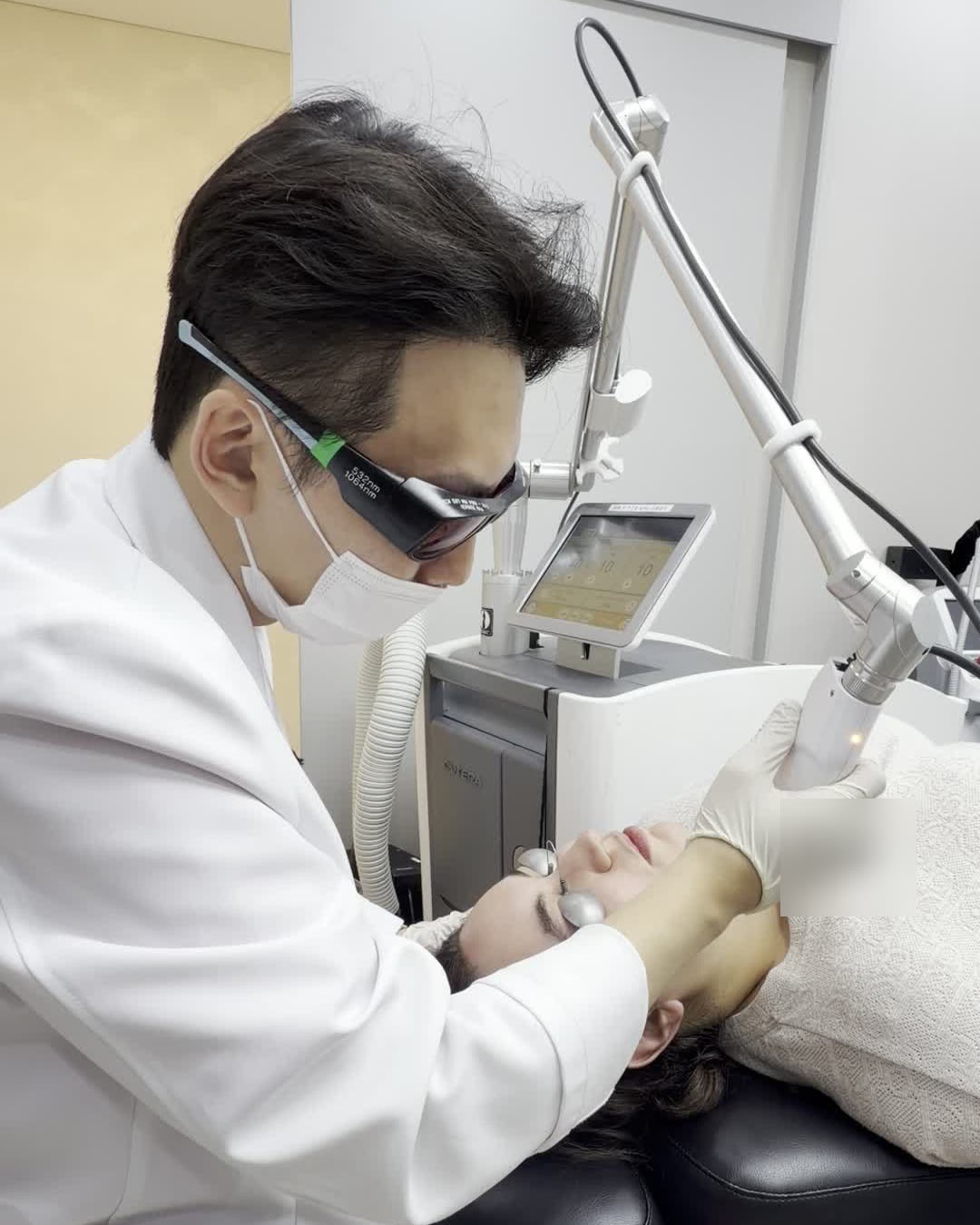
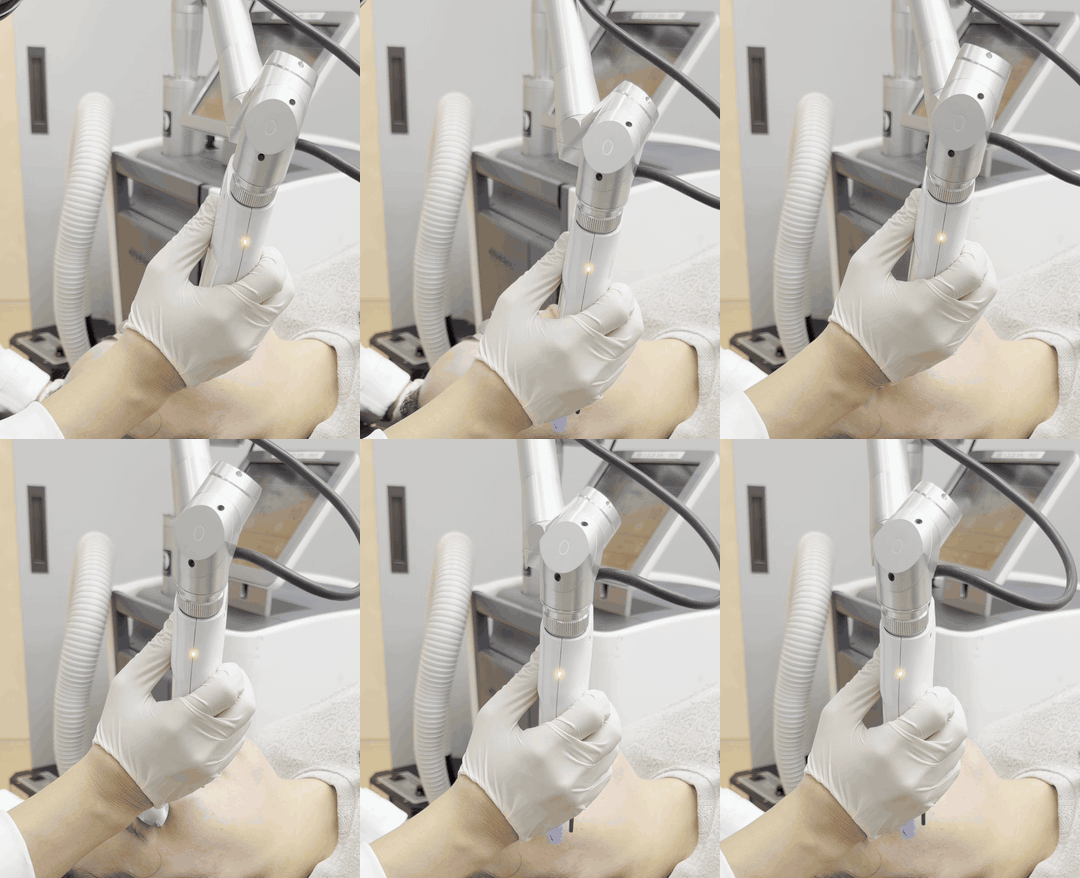
In the clinic I direct I use two machines: Cutera’s enlighten, a picosecond laser with three wavelengths (1064, 532 and 670 nm), and Lutronic’s Clarity Pro, a long-pulsed laser with two (755 and 1064 nm) (Medigate, 2017). A wavelength is the colour of the light; each colour is absorbed at a different depth and by different targets, and the skin types each one is cleared for differ. No study has tested the combination below as a protocol. It is my practice, built on the device clearances and the trials in this piece, and it is not the only reasonable way to do it.
- Melasma. Picosecond 1064 nm at low energy, sessions weeks apart, with tablets and cream. Of the three enlighten wavelengths, 1064 nm is the one cleared for pigment in every skin type (FDA K182997).
- Freckles and sun spots. Picosecond 532 nm, spot by spot, to a slight whitening. Cleared for pigment in skin types I to IV.
- Sun spots in lighter skin. Picosecond 670 nm, which is cleared for pigment in skin types I to III only. In one small study, 15 patients with sun spots were 95 to 100% clear three months after one session; the study included type IV skin, which is outside that clearance, and temporary lightening or darkening occurred in some participants (Evangelista 2021). I found no 670 nm data for melasma, so I do not use it there.
- Larger, flatter sun spots and widespread freckles. Long-pulsed 755 nm on the Clarity Pro. In a split-face trial of 20 Asian patients, long-pulsed alexandrite cleared freckles and sun spots as well as a Q-switched one, with darkening in 6% against 22% (Ho 2011). A later review of records from the same group found little improvement and 20% darkening with long-pulsed alexandrite (Ho 2012), so it is one tool for me, not the default.
- The Clarity Pro’s long-pulsed 1064 nm I keep off melasma. Its US sibling, a different model called CLARITY II, is cleared for sun spots and melasma (FDA K183566), but on a melasma face I prefer the low-energy picosecond 1064 nm. That is my clinical choice, not something a trial has compared.
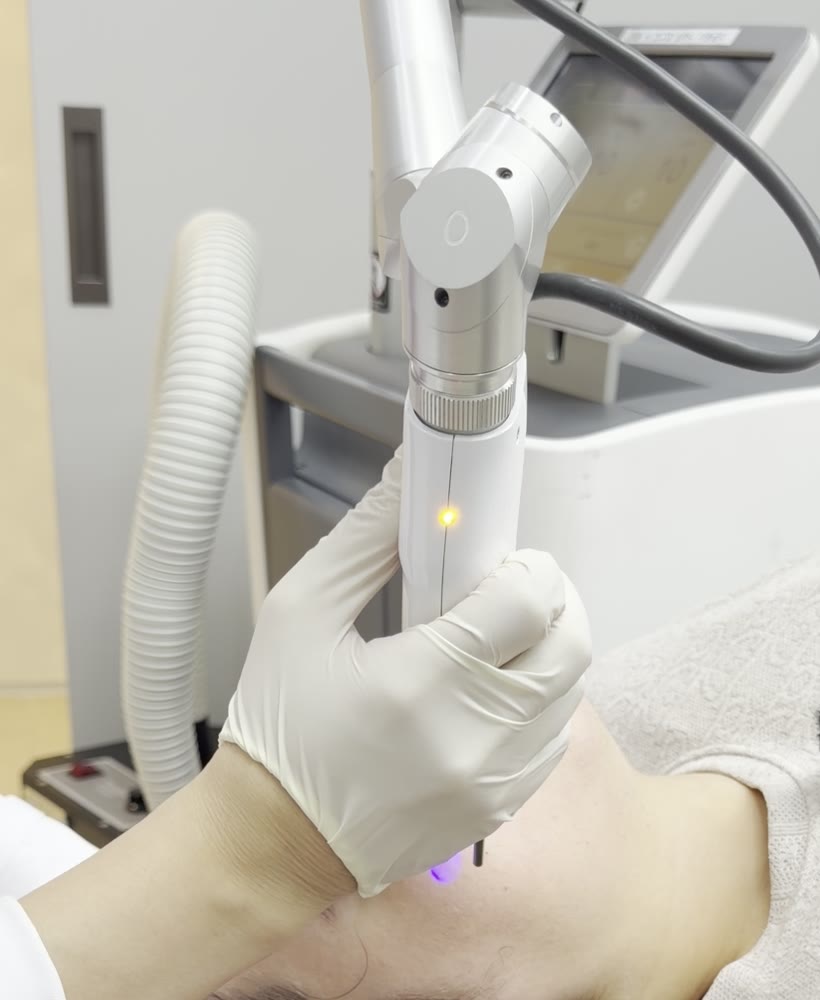
For the woman at the top, that means firm spot treatment for the dots on her nose, gentle toning with tablets and cream for the patches on her cheeks, and never the freckle setting on the melasma.
Who needs to worry most about darkening after laser?
Post-inflammatory hyperpigmentation, or PIH, is brown left behind by the inflammation of treatment, and it is more likely the darker the skin. Dermatologists grade skin by how it reacts to sun, from Fitzpatrick type I, which always burns, to type VI, which never does. Most of the studies above were in Asian patients with types III to V, and their PIH rates were high enough that the risk decides the setting. After Q-switched lasers, rates of up to about a quarter have been reported in skin of colour (Kung 2019). Sun spots darken more readily than freckles: in one study of Asian patients, 8 of 17 with sun spots and 1 of 15 with freckles developed PIH after the same laser (Wang 2006).
What lowers the risk is mostly the setting: a slight endpoint rather than a heavy one (Negishi 2013), each wavelength kept within its clearance for your skin type, and strict sun protection before and after. Tablets are not a shortcut. In one randomized trial after 532 nm treatment of sun spots, tranexamic acid did not reduce how often PIH appeared; only the clearance seen under a skin microscope was faster at 12 weeks (Rutnin 2019). If your skin is type III or darker, ask what endpoint your doctor aims for, and what the plan is if a spot darkens.
Is a picosecond laser better than a Q-switched one?
Small trials have not found better clearance with picosecond lasers; some found less pain or more satisfaction. For sun spots on the arms, 532 nm picosecond and nanosecond lasers showed no significant difference in clearance, with higher satisfaction on the picosecond side (Vachiramon 2018). For melasma, picosecond and nanosecond 1064 nm showed no significant difference, with less pain from the picosecond (Feng 2023). For freckles, one small split-face study found a Q-switched alexandrite cleared better than a picosecond 532 nm (Ma 2022). The machine matters less than which spot it is aimed at and the endpoint chosen with it.
The question to take to your consultation
Ask: “Which of my spots are melasma and which are freckles or sun spots, and will you treat them differently?” If the answer is one setting across the whole face, ask why.