Care · Decisions
Onda for a double chin and a belly: what microwave fat treatment can and cannot do
Why Onda is comfortable, what "targeting the fat layer" really means, what the studies measured on the chin and abdomen, and what to ask about the injection that often comes with it, from the physician who designed two Onda programs.
A man in his late thirties sits down and gets to the point. “Nothing that hurts, and nothing that keeps me off work. Just this,” he says, pinching the soft fullness under his chin, “and, honestly, this,” touching his belt line. He is not asking to lose weight. He is asking whether a machine can take off the part that diet and the gym have not. (A composite of several consultations, not one patient.)
That conversation is why I put together two Onda programs at the clinic I direct, one for the area under the chin and one for the abdomen. The short answer I give him: Onda is comfortable, the changes measured in studies are modest and came after several sessions, and the injection that often comes with it deserves more questions than the machine. Below is the longer version.
What is Onda, and why is it called “Onda lifting”?
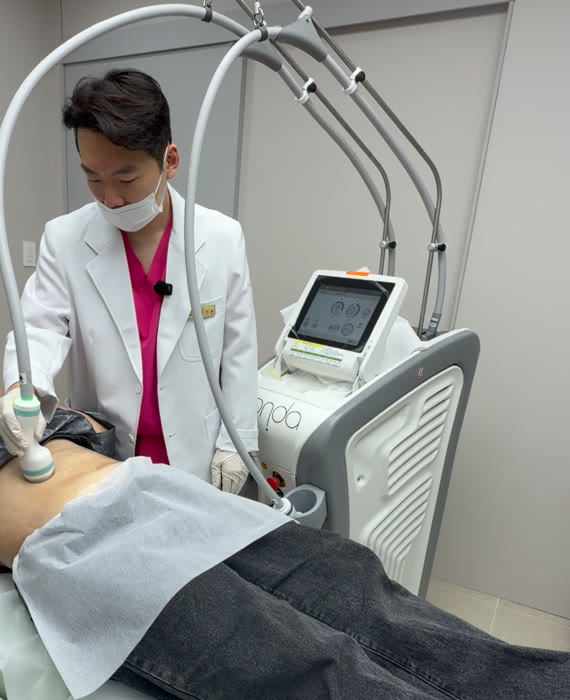
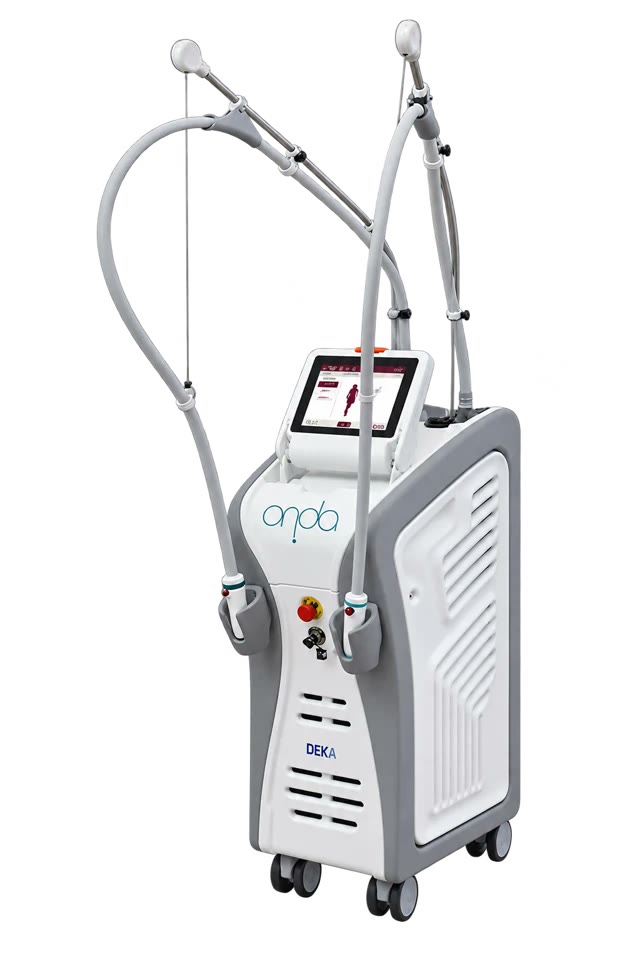
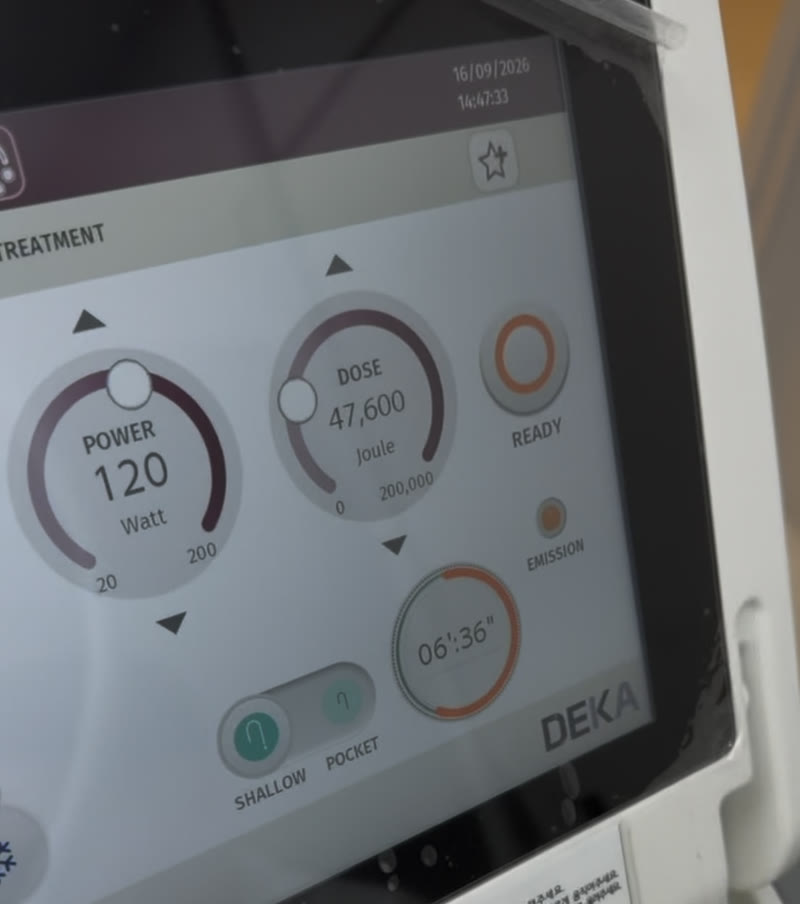
Onda is a device from the Italian company DEKA that sends 2.45 GHz microwaves into the skin through a handpiece with a cooled contact plate. The company describes three handpieces: Deep for localized fat, Shallow for cellulite, skin tightening and the area under the chin, and Pocket, a small one for the face (DEKA; ONDA PRO brochure). “Onda lifting” is the name it carries in Korean clinics. The device is mostly about fat and skin quality, and lifting is the marketing word.
Does Onda hurt?
This is the first reason I chose it. Men who have put off treatment for years usually say the same thing: they are not afraid of the result, they are afraid of the needle or the heat. With Onda, the surface is cooled while the energy goes underneath, and the consensus of physicians who use it describes the usual experience as slight discomfort, mild tingling and temporary redness (Hoffmann 2024). In my experience, most men go back to work the same day after Onda on its own.
The only head-to-head comparison I found is a Korean study of 171 patients treated on the face: pain scores averaged 2.3 out of 10 with a microwave device against 4.7 with focused ultrasound (HIFU), with fewer side effects (Nam 2026). The same study found HIFU ahead on visible improvement at three months, and the abstract does not name the device brand. Comfortable is not the same as stronger.
Comfortable is also not the same as risk-free. The same consensus lists burns, blisters, nodules and numbness as possible, and fat damage or fluid collections with improper use (Hoffmann 2024). That is why the handpiece and the energy are set by a doctor after examining the area, not by a menu.
Can it really target the fat layer?
This is the second reason, and the one that needs the most care. The design does aim at fat: the consensus settings run the contact cooling at about 5 degrees Celsius, while the Deep handpiece spreads heat broader and deeper, where the fat sits (Hoffmann 2024). DEKA’s brochure quotes about 3 mm for the small Pocket handpiece and about 7 mm for Shallow (ONDA PRO brochure). Choosing the handpiece is choosing the depth.
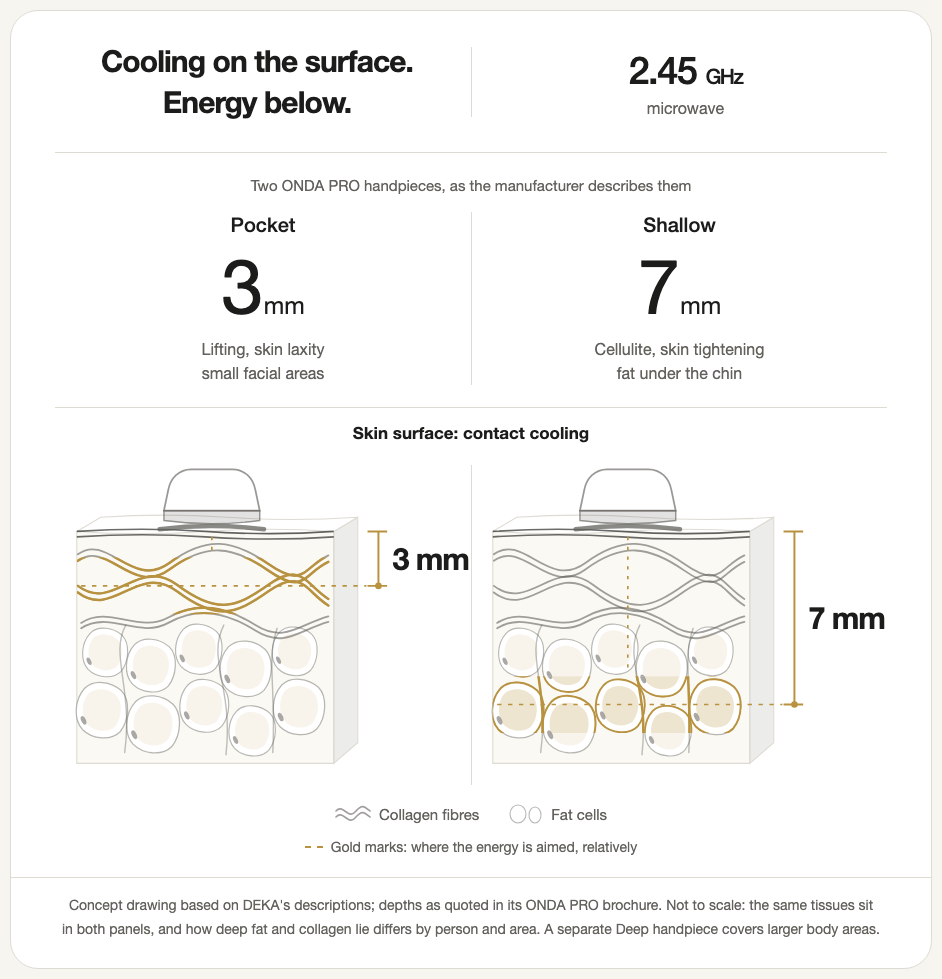
What “targets fat” does not mean is that fat soaks up microwaves better than skin. Fat holds little water, and data at 2 GHz describe it as a lower-loss tissue than skin, absorbing less energy per volume (Asan 2017). The effect on the fat layer comes from cooling the surface and from how the handpiece shapes the field. That explanation comes from the manufacturer, and the animal tissue study often quoted for it was retracted in 2020 (retraction notice). So I put it this way: Onda is designed to put its heat into the fat layer while cooling the surface, burns are still possible, long-term data are still missing, and the studies below show changes after treatment rather than proof of how the design produced them.
What did the studies measure on the abdomen?
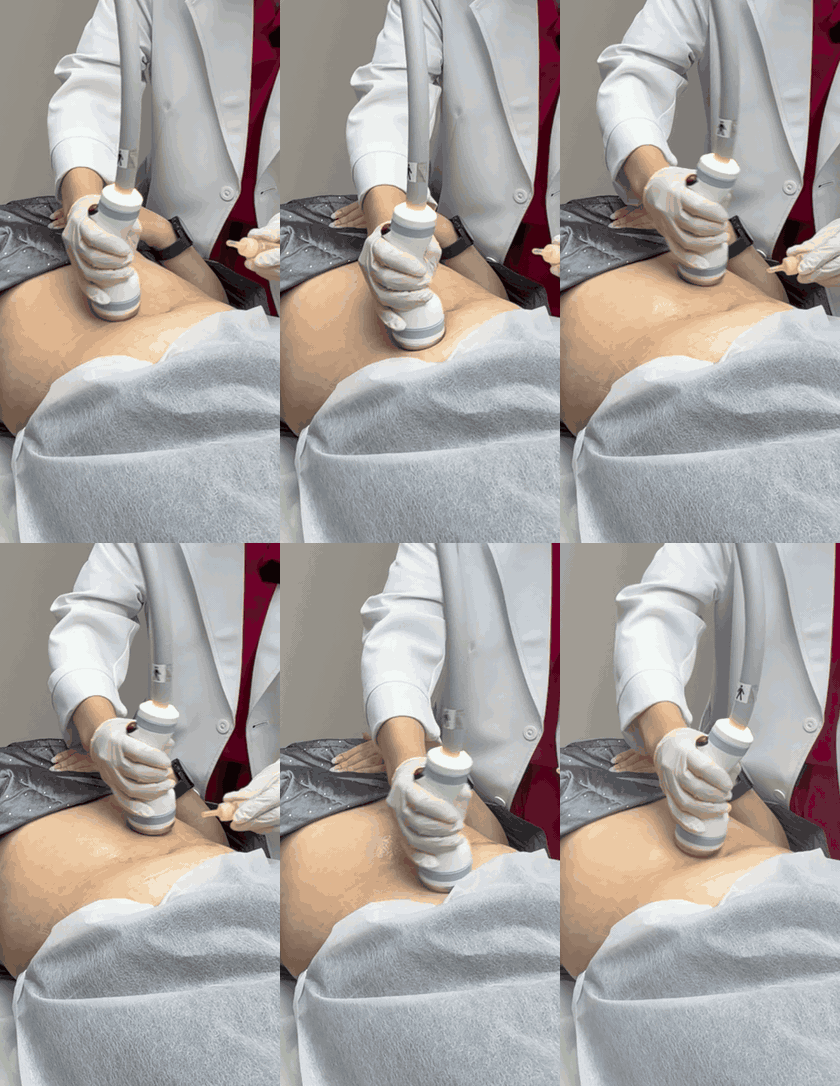
Changes of a few centimetres, in small studies without control groups. In 19 adults, nine of them men and none obese, three sessions four weeks apart reduced waist circumference by 3.8 cm on average at three months (Bonan 2023). In 20 patients measured with 3D imaging, abdominal circumference went from 85.2 to 80.8 cm after four sessions (Clementoni 2023). An ultrasound study found fat under the skin thinned from 9.8 to 8.0 mm, though magnetic muscle stimulation was added, so not all of it can be credited to Onda (Nistico 2022). All three are linked to the manufacturer.
These are averages from small studies after several sessions, not a prediction for one visit. It suits a man with a stubborn pocket at a stable weight, not one who wants to lose ten kilograms.
And under the chin?
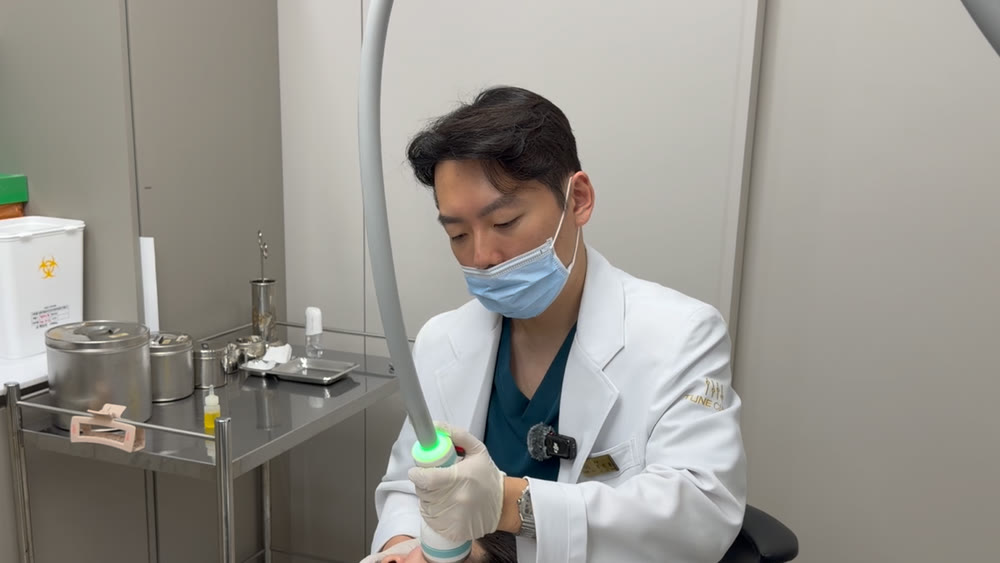
In 48 people given six short sessions two weeks apart, the rating of fat under the chin fell from 3.4 to 1.7 at 12 weeks, with no side effects reported (Salsi 2022). With the small Pocket handpiece, 10 women saw their average skin laxity score under the chin fall from 3.6 to 2.3 on a four-point scale, 12 weeks after two sessions; fat was not measured (Zappia 2025). Neither study had a comparison group.
Is Onda FDA approved?
In the United States I could not find a clearance under the Onda name. The closest match, a 2.45 GHz system from DEKA’s parent company with the same three handpiece names, called SPECCHIO, is cleared for heating tissue and for temporarily reducing the appearance of cellulite, not for fat reduction or lifting (FDA K260647). Matching specifications do not prove it is the same device. Korea regulates it separately.
Why combine it with other treatments, and what should you ask about the injection?
Onda is the comfortable part of both programs. The chin program adds InMode’s Mini FX, a small handpiece that draws the skin in with suction and heats it with radiofrequency, and a fat-dissolving injection; the abdomen program adds the injection. Combining them is my clinical choice for a single visit; the studies I cite did not test this combination.
Be clear about what each part brings. Mini FX is cleared in the US for muscle aches, circulation and the appearance of cellulite, and I found no published study of it under the chin (FDA K160329). The injection has the strongest evidence of the three, for one specific product: in a trial of 506 people, 70.0% of those given ATX-101, a deoxycholic acid injection sold as Kybella, improved by at least one grade on both doctor and patient ratings, against 18.6% on placebo, over up to six treatments (Jones 2016).
It can also add real swelling. On its US label, swelling followed in 87% of patients, numbness in 66%, injury to the small nerve that moves the lower lip in 4%, usually resolving over weeks to months, and difficulty swallowing in 2% (Kybella label). The same label says it is not approved, and not recommended, outside the area under the chin, and that lumps after such use may not resolve. A 2019 review found ten articles on other areas, and its summary lists no abdominal trial (Sung 2019). These numbers belong to Kybella; another injection may behave differently. Ask for the product name, its ingredients, concentration and dose, and whether it is approved for that area, for the chin and especially for the belly.
How many sessions, and when will I see a change?
The Onda studies above used two to six sessions, generally two to four weeks apart, and judged results at about three months (Bonan 2023; Salsi 2022; Zappia 2025). If you are visiting Seoul, know that our programs are one treatment visit and a check at 30 days, while the published results came from courses of treatment. I tell men plainly that one session is a start, that the change is gradual, and that at the 30-day visit we look at it together and decide whether more is worth it.
The question to take to your consultation
Ask three things: “Which handpiece will you use and why? How much energy in total? And what exactly is in the injection?” Then ask what recovery will look like for you, and what else might suit you better. A clinic that answers all of it has thought about your chin or your belly, not just the package.