Care · Process
Juvelook Volume: why preparation starts a day ahead
My 24-hour hydration routine for Juvelook Volume, how it is injected, and why neither step can rule out nodules.
She has read the forum threads. The one about a hard bump under someone’s cheek that showed up four months after a collagen-stimulating injection, and the reply underneath that says lumps are simply what this kind of product does. She is a composite of many consultations rather than one patient, but the question arrives word for word: “Will I get nodules with Juvelook?”
I tell her I cannot promise zero. Nodules can occur after Juvelook even with careful preparation. Then I walk her to the bench at the back of the treatment room, because part of the answer is sitting there, and it started yesterday.
What is a nodule after Juvelook?
A nodule is a distinct lump that can be felt in or under the skin, whether or not it is visible. After an injectable treatment the word describes a finding. It does not say what caused it.
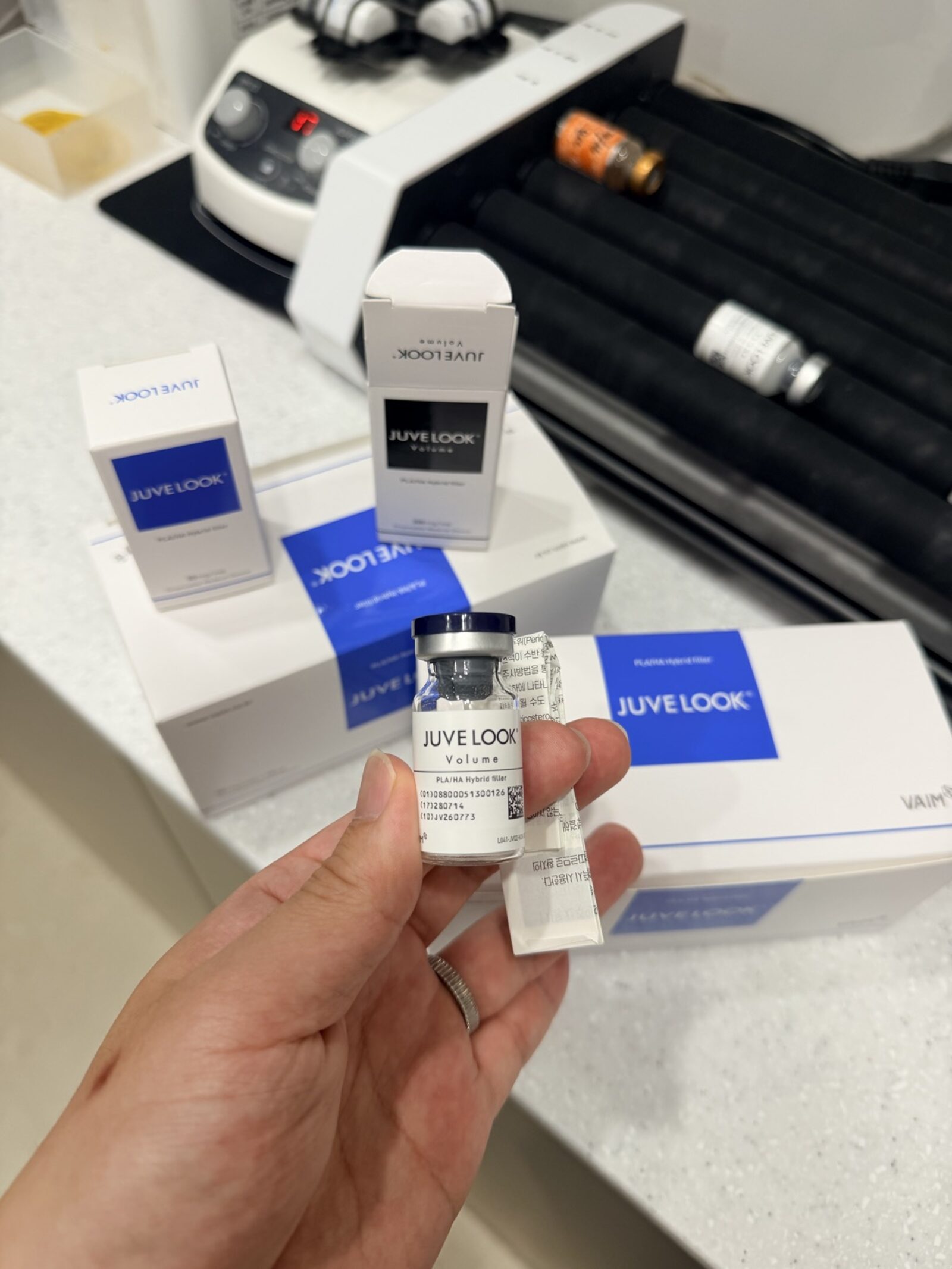
The product on this bench is Juvelook Volume. It contains poly-D,L-lactic acid (PDLLA), a material the body gradually breaks down, blended with hyaluronic acid. The powder is mixed with liquid before injection, a step called reconstitution. The fullness she sees on the day is mostly that liquid and some swelling. The part that lasts is collagen, which the skin builds around the particles over the following months.
A concentrated deposit of particles is one possible reason for a lump. Inflammation can be another, and a clinician may need to rule out infection. Feeling a lump cannot tell you whether the vial was prepared badly or placed badly. A new lump deserves an assessment rather than an assumption about its cause.
How long is Juvelook Volume hydrated before injection?
In my clinic, Juvelook Volume is hydrated for at least twenty-four hours before injection and kept moving for the whole of that time. This is our preparation protocol. It does not prove that a longer wait lowers the risk of nodules.
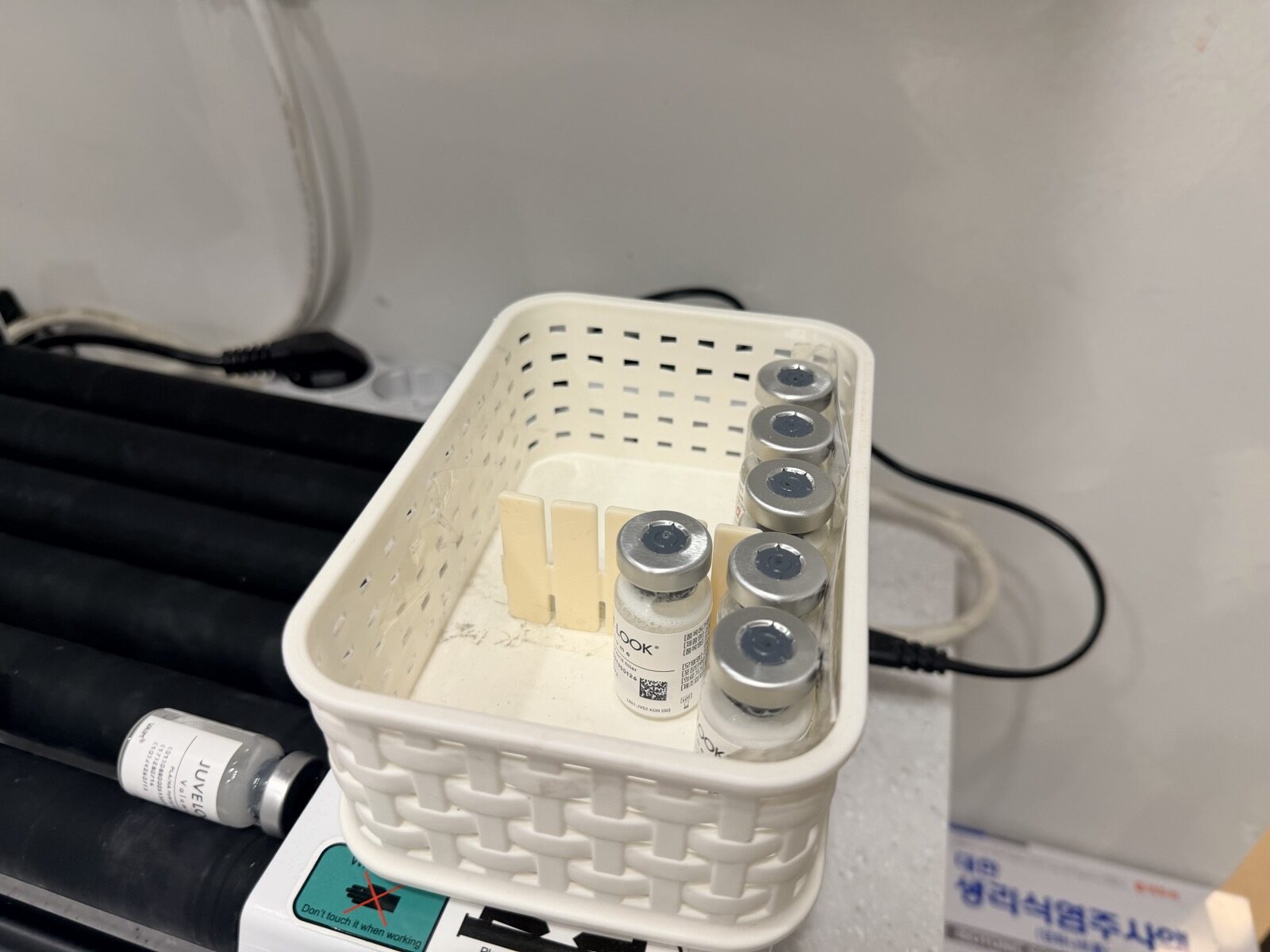
On the bench there are two machines. One is a small platform that holds six vials in clamps and shakes them without stopping. The other is a row of black rollers, the kind used in laboratories, that turns vials slowly on their sides for hours. Next to them is a basket of vials that have finished their time, and a timer that is counting.
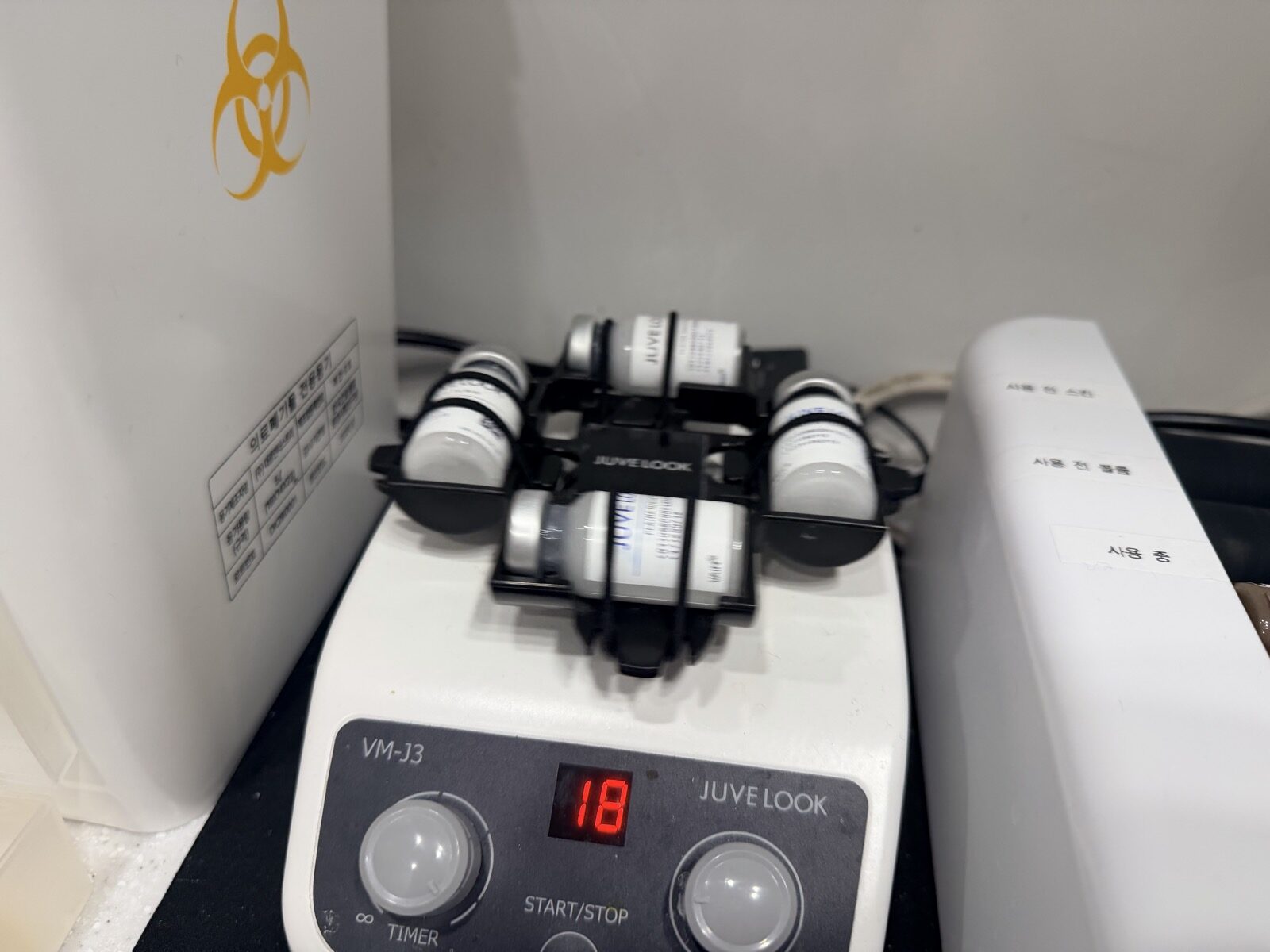
Hydration here means letting the powder take up the liquid it was mixed with. It has nothing to do with skin hydration. A vial looks ready after a minute: it is cloudy and it would go through a needle. Appearance is not the test. The particles take up water slowly, and the ones inside a dry clump take the longest, so the timer decides when a vial leaves the bench, not the look of it.
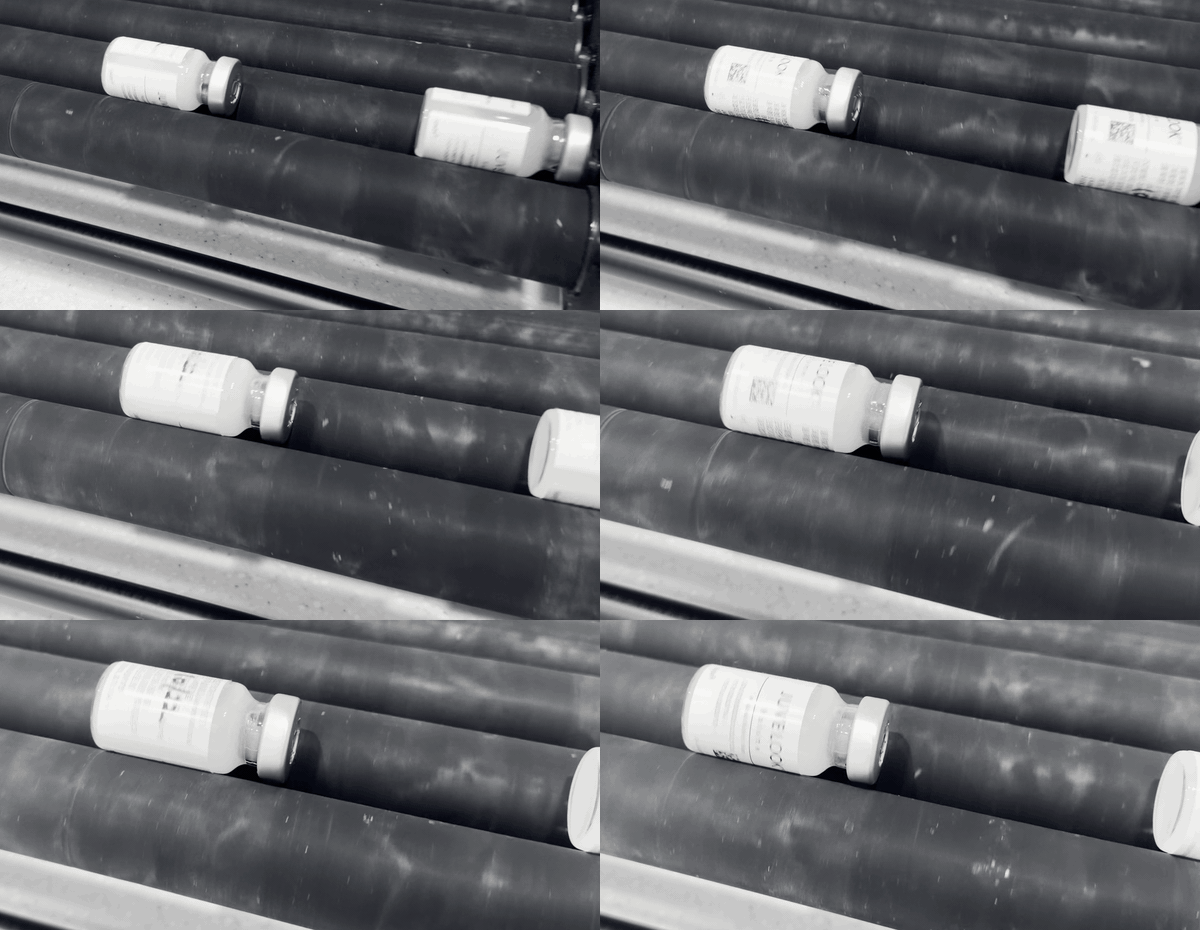
The machines are there because continuous mixing for a day cannot be done by hand. A vial left standing settles, so what is drawn up in the morning is not what was mixed the night before. If we are short on vials prepared this way, we reschedule.
In a randomized split-face study published in 2026 by Park and colleagues, funded by the manufacturer, Juvelook Volume and a poly-L-lactic acid product were reconstituted, left to stand for twenty-four hours, and vortexed for thirty minutes before injection in 33 people. That study compared the two products. It did not test whether a longer wait or continuous mixing changes the rate of nodules. The day on the rollers is the routine we have chosen, with the product’s own instructions as the reference for diluent and storage.
How is Juvelook Volume injected in this routine?
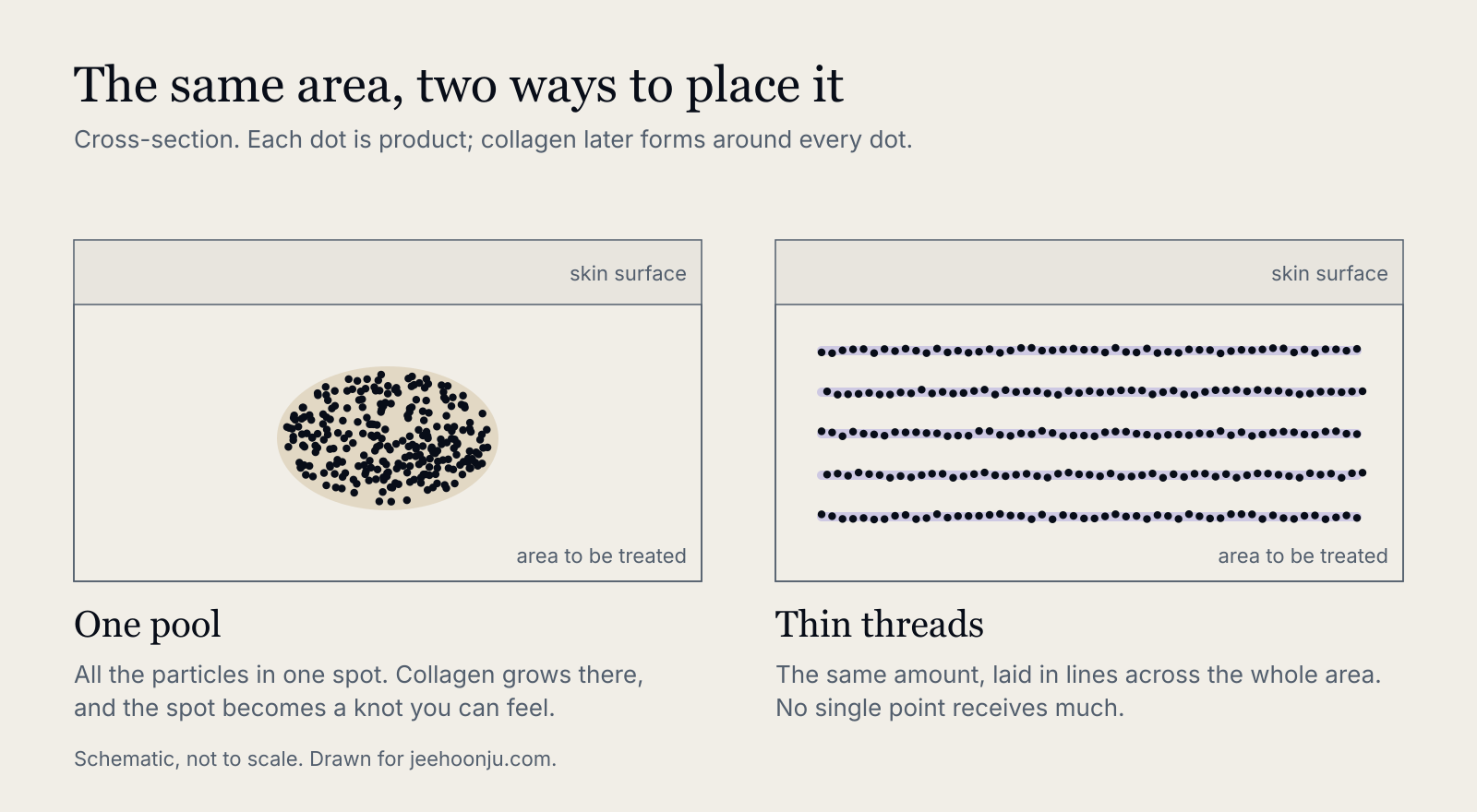
In this routine, Juvelook Volume is released in thin lines as the needle or cannula is withdrawn, so that small amounts are spread across the treatment area. Spreading the product does not rule out nodules.
The quickest way to add volume to a cheek is to put a single deposit of product where the cheek is flattest. With a collagen stimulator that is the pattern we avoid, because it concentrates the particles in one place. So the next line is laid beside the first, until the planned area has been covered and no single point has received much. If you picture the difference, think of seeding a lawn rather than planting one tree. The picture explains distribution, not depth. Placement still has to suit the product and the area being treated.
This takes longer, and the result on the day looks less dramatic. The collagen response develops over the following months, and the appearance on the treatment day cannot tell her how it will develop.
What should you ask about Juvelook preparation and injection?
Ask how long the vial will have been hydrating when it reaches you, and how the product will be distributed across the area. The answers should describe the clinician’s plan for the exact product being used.
She came in asking whether she would get nodules, and nobody can answer that for her with a yes or a no. I provide this treatment, so I have an interest in how she hears that.
She now knows what to ask about preparation and injection, although those answers cannot predict whether she will develop nodules.
Before your appointment, ask how long your vial will have been hydrating.