Care · Decisions
Lafullen: what a PCL collagen stimulator can and cannot promise
How Lafullen differs from Ellansé, Sculptra and Juvelook, what "two years" means, what the nodule studies say, and which online claims hold up, from a physician who injects it.
A woman in her forties sits across from me with her phone open to a clinic’s menu. She points at a line that says Lafullen and asks the question I hear most weeks: “Is this the one that lasts two years?” I ask her what she would do if she disliked a result that lasts two years. Her question is about duration. The decision also turns on that second question. (A composite of several conversations, not one patient.)
I inject Lafullen in my own treatment room, and the clinic I direct sells it. Keep that in mind as you read what follows, including the part where I check the claims clinics make about it online.

What is Lafullen, and what does “collagen stimulator” mean?
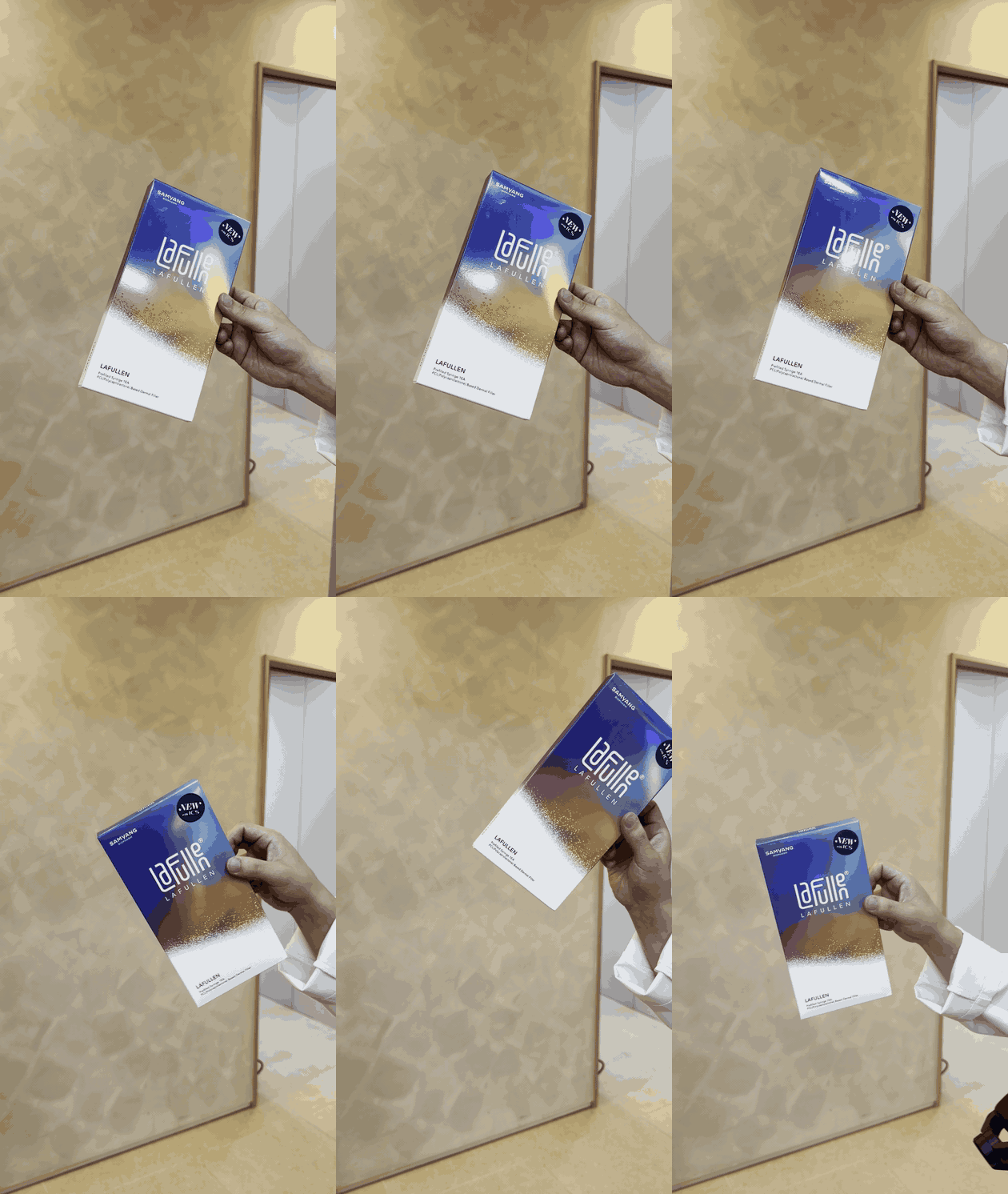
Lafullen is a Korean injectable made of polycaprolactone (PCL), a slowly biodegradable polymer, shaped into tiny spheres and suspended in a gel. “Collagen stimulator” means the spheres stay in the tissue and your own collagen-making cells, fibroblasts, lay down new collagen around them; the gel is what you see in the mirror on the day. The clearest human evidence is small: biopsies from two patients, 13 months after a PCL filler, showed collagen formed around particles that were still intact (Kim 2015).
When I explain it on camera I say “more compact skin, with collagen replenished”. That is what I am aiming at, not a measured change in firmness.
Samyang filed it as a device to temporarily improve the nasolabial folds, the lines from nose to mouth, and Korea’s Ministry of Food and Drug Safety approved it in 2021 (BioSpectrum, 2022; Korea Economic Daily, 2023). Any other area of the face is the injector’s judgement, not the label.
How is it different from Ellansé, Sculptra and Juvelook?
Lafullen and Ellansé are the same family: PCL spheres in a carrier gel, usually a single session, with fullness on the day. Sculptra and Juvelook are a different polymer, polylactic acid, usually given as a course, and Juvelook also carries hyaluronic acid (Park 2026). On camera I put it as different brands, different polymers, one purpose: new collagen of your own. For you, the practical difference is whether you want fullness on the day or a course with gradual change. (I wrote separately about how I prepare Juvelook Volume.)
Between Lafullen and Ellansé, the manufacturer says Lafullen’s spheres are porous and uniform in size and links that to easier injection (BioSpectrum, 2022). That description does not tell you whether Lafullen gives a better result than Ellansé, and I could not find an independent comparison of the two.
With the polylactic acid products, I tell patients that much of what they see on the day is the carrier and will go. With a PCL product more of the early fullness is meant to stay, though how much has not been measured. So the question under “which is better” is how much early fullness you want, and how much you are willing to live with if you change your mind.
How long does Lafullen last, and what are the first weeks like?
The company claims more than two years. The first weeks are swelling and sometimes a bruise while the carrier gel settles. Lafullen’s own study followed 59 Korean adults for 24 months, and the release reports no numbers (Samyang, 2022). The better-documented member of the family, Ellansé, has a randomized trial in 40 people with nasolabial folds in which most were still improved at two years, a study its manufacturer funded (Moers-Carpi 2013). For now, these sources cannot tell you how long a result you like will last on your face.
One thing the menu leaves out: duration cannot be switched off. A hyaluronic acid filler can be dissolved with hyaluronidase; a PCL filler cannot, and a 2024 review lists expression or removal, not dissolution, for problems with non-hyaluronic fillers (Hong 2024). There is no dissolving injection for PCL, so managing an unwanted result depends on what the problem is. The two-year number that brought you in is the same number that should make you choose the injector more carefully than the product.
In a published series of 1,111 treatments with a PCL filler, bruising followed 2.7% of treatments and swelling beyond two weeks followed 4.5%, more often with larger volumes (Lin 2020). New collagen is slow, so I ask my own patients to judge the result at three months, not at three days.
What do the nodule studies actually say?
I could not find a published nodule rate for Lafullen itself, so here is what the two closest studies show.
One dermatologist’s record of 1,111 Ellansé treatments in 780 patients over three years recorded no nodules, no granulomas and no intravascular injections (Lin 2020). It is one clinic, one experienced hand, looked at in hindsight, with a company scientist as co-author. It does not set Lafullen’s risk.
A Brazilian series of 55 complications after collagen stimulators, collected by ultrasound specialists, found nodules in 89% of cases, most appearing after the first month (Ianhez 2024). PCL products were 7.3% of a series dominated by polylactic acid. Only five of the 55 resolved completely, and the authors read the products’ properties, more than technique, as the explanation. A series of complications cannot say how often they happen. It shows what one looks like: late, firm and slow to treat.
Which claims about Lafullen online hold up?
Search for Lafullen in Korean and four claims come up again and again. Each has something behind it, and none is the whole story.
“It lifts the face without surgery.” You will see it sold as non-surgical contour fixation. One four-patient report, using diluted Lafullen under ultrasound guidance at the side of the face, described improved volume and contour and a visible lift, with no comparison group and no follow-up period given in the abstract (Wan 2025). It is an early signal; it does not establish a lasting “fixation”. The approved use is still the nasolabial folds.
“It is a third-generation collagen injection.” The label, by itself, does not show that a product works better or is safer than an earlier one.
“Uniform particles mean no lumps.” Uniform particles do not establish zero nodule risk, and I could not find a published comparison of Lafullen’s nodule rate with another product’s.
“If something goes wrong, nothing can be done.” Cannot be dissolved is not the same as cannot be treated. PCL does not dissolve the way a hyaluronic acid filler does, but some complications respond to treatment. In one published case, lumps appeared about four months after a PCL filler, which the authors linked to a stomach virus. Steroid injections placed blind did not reach the filler, which lay deep; injections guided by ultrasound, with a course of oral minocycline, gave a satisfactory result at four weeks (Shekarriz 2022). It took a scanner, a second attempt and a month.
The question to take to your consultation
You came in asking which product lasts longest. Ask instead: “If a lump appears two months from now, how will you assess it and what will you do?” Then ask for a clear follow-up plan, including whom to contact if it appears after you are home.